Design Guide · Blog 4
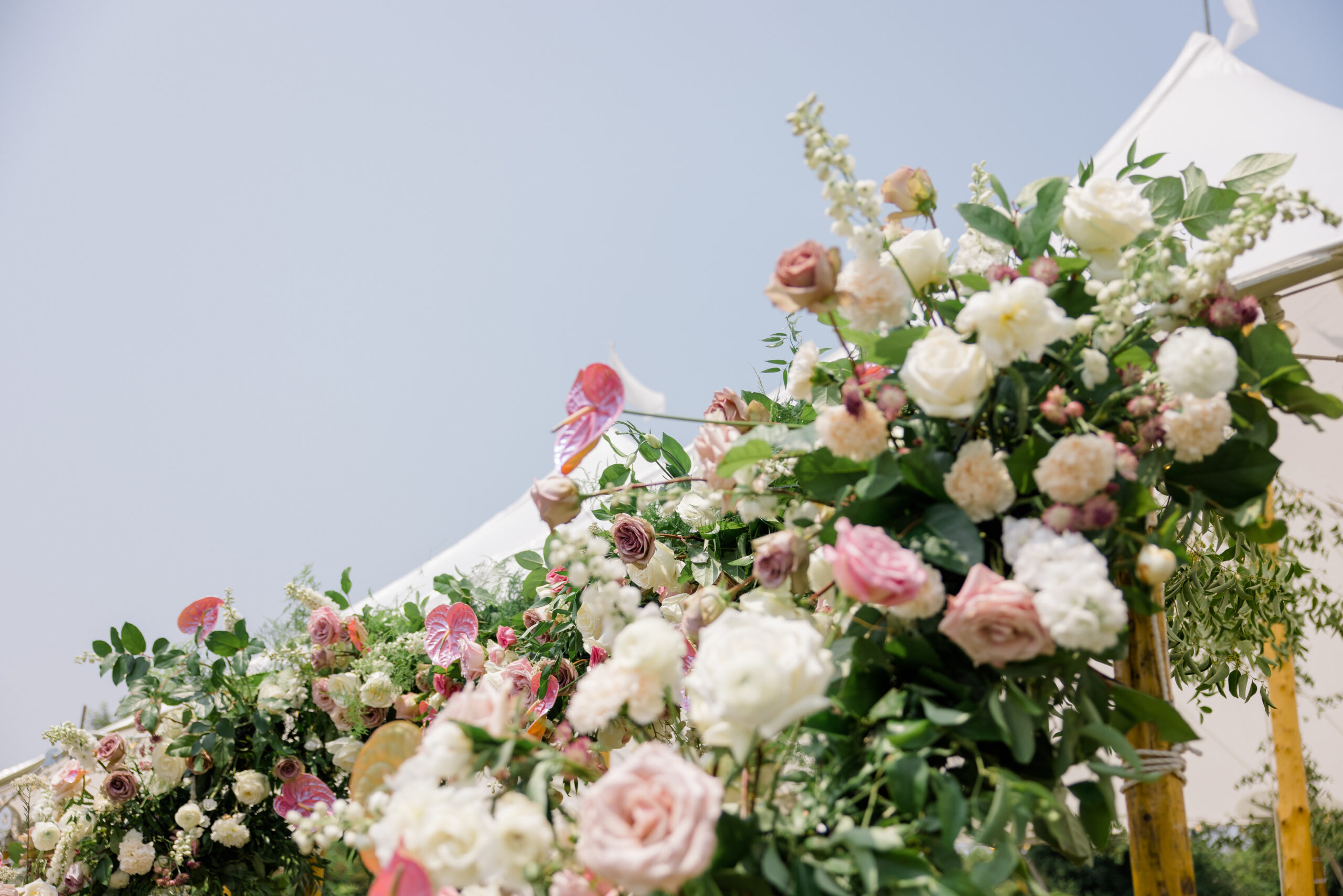
Newport RI Wedding Flower Style
Organic
Modern
Coastal
Architectural
Belle Mer
The most common design mistake I see couples make isn’t choosing the wrong flowers. It’s choosing a floral style that wasn’t built for their venue.
It happens all the time. A couple falls in love with an inspiration photo—lush, wild garden arrangements cascading across a weathered farmhouse table—and books their Newport wedding at Rosecliff Mansion. The arrangements arrive beautifully. And then something feels slightly off. Not wrong, exactly, but not quite right either. The room and the florals are having two different conversations.
Floral style is not just an aesthetic preference. It’s a design decision that either works in conversation with a venue’s architecture, light, and surroundings—or it works against them. Getting this relationship right is one of the most important things we do at Plant Girl Floral, and it’s where deep venue knowledge becomes genuinely indispensable.
This guide walks you through the three primary Newport RI wedding flower styles—classic, organic, and modern—and shows you exactly how they map to different venues, different light conditions, and different architectural characters. By the end, you should be able to look at your venue and your inspiration and know whether they belong together.
Three Floral Styles — One Right Fit for Every Venue
Classic & Romantic
Structured, symmetrical, and intentionally refined. Classic design uses traditional florals—roses, peonies, ranunculus, garden whites—arranged with precision and a clear sense of order. It reads as timeless rather than trending.
Organic & Garden
Loose, abundant, and naturalistic. Garden-style design prioritizes texture and movement over symmetry—trailing vines, mixed blooms, wildflower elements, and arrangements that feel grown rather than constructed.
Modern & Refined
Architectural, editorial, and restrained. Modern design favors sculptural shapes, negative space, unexpected bloom choices, and a design confidence that knows when to stop. Less is intentional, not incomplete.
Matching Floral Style to Venue Architecture
Every venue communicates a design language through its architecture—its proportions, materials, ornamentation, and overall character. Florals that speak the same design language as the building will feel inevitable. Florals that contradict it will always feel like visitors.
This is not about restriction. It’s about the difference between design tension that works and design tension that doesn’t. A maximalist organic garden arrangement can work beautifully at a formal mansion—but only if it’s been thoughtfully calibrated to the space, not simply imported from an inspiration board.
- Florals must match the room’s scale—small pieces disappear
- Symmetry and structure feel native to the architecture
- Organic wildness can work but must be intentionally calibrated
- Florals should complement, not compete with, the view
- Restraint reads as sophistication here
- Clean palettes and refined arrangements feel right
- Organic, garden-style design feels native to the space
- Formal or structured arrangements compete with the venue
- Abundance in texture is rewarded; scale should stay intimate
- All three styles can work—the tent is a genuine blank canvas
- Statement installations define the space in the absence of architecture
- Investment in overhead elements pays off here uniquely
Classic & Romantic Design at Rosecliff Mansion
Classic floral design is defined by intentionality of form. Arrangements have structure, the eye knows where to look, and the palette reinforces a clear aesthetic direction rather than exploring in multiple directions at once.
At Rosecliff, this approach feels completely native. The mansion’s Beaux-Arts architecture—its perfect proportions, carved plasterwork, and sweeping grandeur—responds to design that shares its values: precision, elegance, and a clear sense of occasion.
This doesn’t mean rigidity. Classic design at its best has warmth and softness within its structure—garden roses that are densely petaled rather than formal, arrangements that have depth even while maintaining symmetry. The goal is always romantic grandeur, not sterile formality.
The grand staircase at Rosecliff is perhaps the best single opportunity in Newport for classic floral design. A pair of statement urns at its base—roses, garden whites, trailing smilax—scaled to the architecture creates a moment guests will photograph and remember for decades.
Organic & Garden Design — When the Space Calls for It
Organic floral design is the most misunderstood of the three styles. Couples sometimes choose it because they love the look without considering whether their venue invites it—and they sometimes avoid it at intimate venues where it would be perfect.
True garden-style design isn’t simply “less structured.” It’s a specific aesthetic vocabulary: movement over symmetry, texture over color uniformity, abundance over precision. It takes more skill to execute beautifully than classic design, because the apparent effortlessness is entirely constructed.
Organic design thrives in venues with warmth, character, and intimacy. Castle Hill Inn is its natural home in Newport—the historic shingle-style property, ocean breezes, and layered interior textures create an environment where garden arrangements don’t just fit, they feel grown specifically for that place.
It can also be calibrated effectively for larger venues when the scale is adjusted thoughtfully. An organic arrangement at OceanCliff needs to be significantly more abundant than the same style at Castle Hill—otherwise it reads as sparse against the backdrop of a tented space.
Trailing elements and movement
Jasmine, smilax, ivy, and other trailing varieties give arrangements a sense of life and direction that static designs lack.
Mixed bloom families
Three to five distinct bloom types within each arrangement creates the layered depth that makes organic design feel genuinely abundant.
Foliage as a primary element
In organic design, greenery is not a filler. It’s a design element in its own right—eucalyptus, fern, fig leaf, and herb varieties add texture and depth.
Irregular silhouettes
Arrangements lean, drape, and extend rather than sitting in perfect globes. The edge of an arrangement should feel like it’s still deciding where to stop.
Earthenware and organic vessels
Vessel choice matters enormously in organic design. Ceramic, terracotta, aged brass, and clear glass complement the style; ornate silver competes with it.
Modern & Refined Design — When Restraint Is the Statement
Modern floral design requires a specific kind of confidence—the confidence to use negative space as a design tool, to let a single bloom make a statement, to trust that less is not a compromise. It is the hardest style to execute well and the easiest to get wrong.
Done right, modern design reads as deeply considered—every element placed with absolute intentionality, nothing present that doesn’t need to be. It is the antithesis of the “add more everywhere” instinct. It rewards venues that have their own strong visual character, where florals serve as punctuation rather than full sentences.
Belle Mer is modern design’s natural Newport venue. The clean glass-and-coast aesthetic, the horizontal expanse, the natural light—all of these reward restraint and penalize visual noise. A refined, edited floral approach at Belle Mer feels sophisticated. An exuberant one competes with the view.
How Light and Surroundings Shift Your Palette
Color doesn’t exist independently. It exists in relationship to the light around it, the surfaces near it, and the natural environment visible from it. A palette that looks perfect on a screen in your living room may read entirely differently under the specific light conditions of your venue on your wedding day.
Newport’s coastal light is particular: bright and diffuse in summer, golden and warm in late afternoon, silver-cool on overcast days. Venues with water views amplify cool tones. Venues with warm interior finishes amplify warm ones. Understanding this before you finalize your palette is essential.
The proximity of the ocean also matters. Venues where the water is a dominant visual presence—Belle Mer, OceanCliff, Castle Hill Inn, The Chanler—create an ambient cool-blue quality in the natural light that affects how every color in your palette reads. Cream reads cooler. Blush reads paler. White can wash out entirely if not properly anchored with depth.
This is why we always ask about your venue’s orientation and your primary indoor/outdoor time before discussing palette. The same bouquet will photograph and appear differently at a south-facing noon ceremony than at a west-facing golden-hour celebration.
Cool coastal light rewards: green-white, soft sage, ice blue, clean ivory. Warm pinks can read as peachy.
Warm interior lighting rewards: blush, champagne, dusty rose, peach-ivory. Cool palettes can look lavender under chandeliers.
Mixed light rewards: earthy greens, warm neutrals, aged white, garden tones. Highly saturated palettes compete with the site.
Clean, Coastal, Refined: Florals at Belle Mer
Belle Mer is the design inverse of Rosecliff. Where Rosecliff asks florals to fill and warm a grand architectural space, Belle Mer asks them to edit and complement an already-beautiful natural one. The Narragansett Bay is doing most of the visual work the moment guests arrive. Your florals need to understand that.
The cardinal mistake at Belle Mer is bringing a floral approach calibrated for a different venue. Heavy, romantic, blush-and-burgundy arrangements that would feel at home in a ballroom can feel heavy and indoor against Belle Mer’s bright, coastal light and open water backdrop.
What works at Belle Mer is confidence in restraint. A clean, refined palette of white, soft green, and ivory—with selective depth in one or two accent tones—reads as sophisticated and intentional. Arrangements that have beautiful silhouettes without excessive density. Ceremony pieces that frame the water rather than obscure it.
This is where modern and organic design approaches often intersect most productively. The organic movement and texture of garden-style design, edited to the cleaner palette and lighter scale that Belle Mer rewards—this is frequently the right answer for couples whose aesthetic sits between the two styles.
Frame the View, Don’t Block It
Ceremony installations should sit beside and below the water view—framing it rather than competing with it. Guests came for the bay. Design with that in mind.
Edit Your Palette to Coastal Light
White, soft green, sage, ice blue, and clean ivory perform best here. Warm blushes can read peachy in coastal daylight. Heavily saturated colors fight the natural palette outside.
Height Mix With Restraint
Alternating tall and low centerpieces works at Belle Mer—but the tall pieces should feel light and airy, not dense. Column-style arrangements with negative space rather than full globes.
Let Repurposing Work for You
Ceremony pieces moved to flank the reception entrance create continuity without adding volume. This is especially effective at Belle Mer’s natural ceremony-to-reception flow.
Use Greenery as Structure
Lush greenery—eucalyptus, fern, fig—can define and structure arrangements at Belle Mer in a way that feels coastal and natural without reading as heavy.
When Inspiration Doesn’t Fit the Space
Inspiration boards are an essential design tool—and a potential trap. Pinterest and Instagram surface the most visually striking images, often from weddings at completely different venues, in different climates, with different architectural contexts. The danger is falling in love with a look without asking whether it belongs in your specific space.
I see this most often in two ways. Couples bring in inspiration from European castle weddings—heavily romantic, deeply saturated, maximally abundant—and want to recreate it at a clean coastal venue where that level of richness will feel incongruous. Or they fall for a spare, modern editorial aesthetic and try to apply it to a grand ballroom that simply needs more visual weight to feel appropriately filled.
Inspiration should inform the feeling you want to create—not dictate the specific execution. My job is to translate the emotional content of what you love into a design that actually works in your specific space. That translation is where the expertise lives.
When you bring inspiration images to your first design consultation, the most useful thing you can do is also articulate what you love about them. Is it the mood? The color? The abundance? The refined restraint? That underlying feeling can almost always be achieved in a way that’s right for your venue—even if the specific approach shown in the image wouldn’t work there.
What type of venue is this image taken in—and how does it compare to mine in scale, architecture, and light?
What specifically do I love about this image—the color, the abundance, the style of arrangement, the overall mood?
Does this palette work in the natural light of my venue, or does it belong in a different kind of space?
Is the scale shown here appropriate for my space—or would it overwhelm an intimate room or disappear in a grand one?
Can I articulate the feeling I want to create—and is that feeling achievable at my actual venue even if this specific look isn’t?
Which Newport RI Wedding Flower Style Is Right for You?
Use this as a starting point—not a definitive answer. The right style emerges from the intersection of your venue, your aesthetic sensibility, and your florist’s understanding of both.
Choose this style if…
- Your venue has grand architecture, high ceilings, or formal proportions
- You want your wedding to feel timeless rather than trend-forward
- You love roses, peonies, and traditional garden whites
- Your inspiration images are structured and symmetrical
- You want florals that feel polished and intentionally elegant
Choose this style if…
- Your venue has warmth, character, and an intimate scale
- You love the look of wildflowers and garden arrangements
- You want florals that feel lush, layered, and slightly wild
- Texture matters as much to you as color
- Your inspiration images feel grown, not constructed
Choose this style if…
- Your venue is clean, contemporary, or has strong natural light
- You’re drawn to restrained, sophisticated aesthetics
- Negative space feels intentional to you, not incomplete
- You value design confidence over abundance
- Your inspiration images feel edited and intentional
“The right floral style for your wedding is never the one that looks best in the abstract. It’s the one that looks inevitable in your specific space.”
— Christine, Plant Girl Floral · Newport, Rhode Island
Let’s Find the Style That’s Right for Your Venue
Every design consultation we do begins with your venue—not your inspiration board. We bring deep familiarity with Newport’s most iconic properties, and that knowledge shapes every design decision we make together.
If you’re planning a wedding in Newport, Rhode Island and want a florist who understands the difference between a style that looks beautiful and one that actually belongs, we’d love to hear about your vision.
Frequently Asked Questions
What is the most popular wedding flower style in Newport, Rhode Island?
The most common approach we design at Newport venues is a blend of classic and organic—structured enough to match the scale of the architecture, but with enough texture and movement to feel warm and romantic rather than stiff. Purely modern designs are becoming increasingly popular at waterfront venues like Belle Mer, where the clean coastal aesthetic rewards restraint and refinement.
How do I know if my inspiration images will work at my specific venue?
The best starting point is asking whether the venue in your inspiration image shares the same architectural character as yours—similar scale, similar formality level, similar light environment. If they’re different, focus on what feeling you love in the image rather than the specific execution. A great florist will translate that feeling into something designed for your actual space.
What floral style works best at Rosecliff Mansion?
Classic and romantic design feels most native to Rosecliff’s Beaux-Arts architecture. The mansion’s grand scale, symmetrical proportions, and ornate plasterwork respond beautifully to structured arrangements, cascading staircase installations, and palettes in blush, ivory, and champagne. Organic garden-style design can also work at Rosecliff when it’s calibrated to the room’s scale—but it requires more design expertise to feel right in a formal architectural context.
Does the coastal light at Newport venues affect which colors I should choose?
Significantly. Newport’s coastal light—especially at water-facing venues like Belle Mer, Castle Hill Inn, and The Chanler—amplifies cool tones and can wash out very pale colors. Cream reads cooler than it does in a warm interior; blush can appear peachy; white without depth can wash out entirely. We always consider your venue’s orientation, time of ceremony, and natural versus artificial lighting environment before finalizing a palette.
Can I mix floral styles, or do I need to commit to one?
Most of our designs exist on a spectrum between styles rather than at one extreme. A classic-leaning palette with organic, garden-style arrangement structure is one of the most beautiful combinations we work with. The key is ensuring the elements you combine share a consistent design language—and that the overall approach is calibrated to your specific venue’s character.

Comments >>